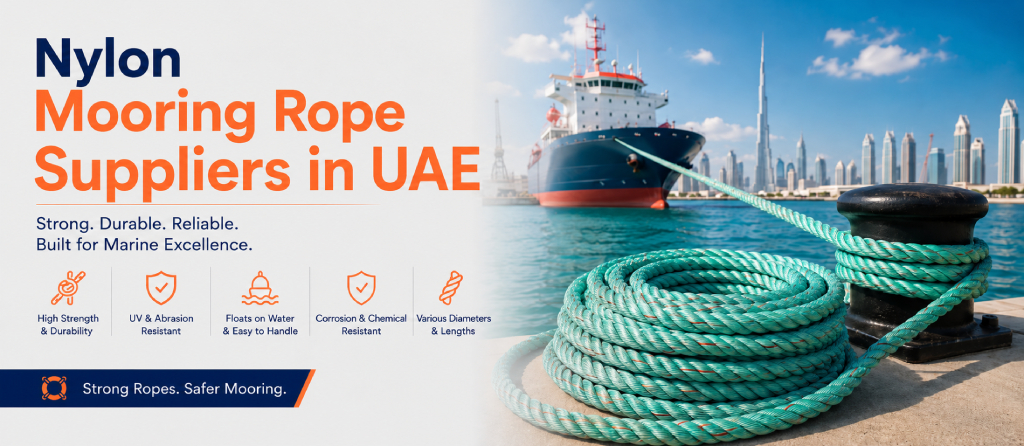
Nylon Mooring Rope Suppliers UAE is a search term used for companies that supply nylon or polyamide ropes designed for securing vessels to berths, buoys, dolphins, pontoons and other approved mooring points in the United Arab Emirates.
Nylon mooring rope is manufactured from synthetic polyamide fibres. Its principal characteristic is controlled elasticity, which allows the rope to absorb and distribute sudden loads caused by vessel movement, swell, wind, tidal changes and operational forces. Nylon is also available in different constructions, including three-strand, eight-strand and braided formats.
The correct rope cannot be selected by material alone. The rope’s construction, diameter, minimum breaking load, length, termination, intended use and compatibility with the vessel’s winches and fairleads are equally important.
Why Nylon Mooring Rope Is Used in the UAE
The UAE is a major maritime and logistics centre. According to the United Nations Conference on Trade and Development, the UAE recorded approximately 21.139 million TEUs of container port throughput in 2024. The country’s busy ports, commercial terminals, shipyards and offshore activities create continuing demand for dependable marine equipment.
Nylon is commonly considered for mooring applications where elasticity and energy absorption are important. Its ability to stretch under load can help reduce the severity of dynamic forces, provided that the rope is correctly specified and used within its approved limits.
Key reasons for considering nylon rope
Elasticity: Nylon can absorb dynamic loading caused by vessel movement.
Shock absorption: Its stretch characteristics may reduce sudden load transfer to fittings and equipment.
Versatility: Nylon ropes are available in different diameters, constructions and lengths.
Marine suitability: Properly manufactured marine-grade nylon rope can be used for a range of approved mooring and anchoring applications.
Availability: Marine procurement teams can source nylon ropes through established UAE suppliers and ship-chandler networks.
Nylon also has limitations. It can lose some strength when wet, may be affected by ultraviolet exposure and can suffer damage from abrasion, heat, chemicals or poor handling. Therefore, the operating environment must be considered before ordering.
How to Evaluate Nylon Mooring Rope Suppliers UAE
Choosing among Marine nylon rope suppliers UAE requires a structured technical and commercial assessment. Ship owners and operators should request information that allows the proposed rope to be compared against the vessel’s requirements.
1. Confirm marine-sector experience
A supplier should understand the needs of commercial vessels, shipyards, offshore operators, ports and marine contractors. Experience with marine ropes, anchoring equipment, shackles, thimbles, tails and related deck equipment is useful because the rope must work with the broader mooring system.
2. Request complete technical details
A professional supplier should clearly state:
Rope material and grade
Rope construction
Nominal diameter
Length and reel or coil arrangement
Minimum breaking load
Wet and dry performance information, where applicable
Recommended application
Splicing or end-termination details
Manufacturing and test documentation
Storage and maintenance recommendations
3. Check documentation and traceability
Documentation is particularly important for safety-related marine equipment. The supplier should be able to identify the manufacturer, product specification, batch or lot information and applicable test certificates. Documentation should be consistent with the actual rope supplied.
4. Assess delivery and technical support
UAE operations may require rapid replacement during planned maintenance, vessel calls or unexpected equipment inspections. Consider whether the supplier can provide dependable delivery, suitable packaging, clear communication and technical assistance after the sale.
Technical Specifications to Check Before Ordering
When comparing Nylon mooring ropes in Dubai or elsewhere in the UAE, procurement teams should review the following specifications.
Minimum breaking load
Minimum breaking load, or MBL, indicates the force at which a new rope is expected to fail under specified test conditions. MBL should not be treated as the permitted operating load. The vessel’s mooring analysis, approved procedures and applicable guidance determine the relevant operational limits.
The IMO’s safe-mooring guidance emphasises compatibility between mooring lines, winches, fittings and the vessel’s design requirements. The guidance also addresses the importance of considering line design breaking force and working load limits when selecting mooring equipment.
Diameter and construction
A larger diameter does not automatically make a rope suitable. Diameter must correspond with the required strength, handling arrangements, fairlead dimensions, winch capacity and manufacturer recommendations.
Construction also affects handling, flexibility, abrasion behaviour, splice requirements and inspection methods. The supplier should explain why a particular construction is appropriate for the intended vessel and duty.
Wet performance and elasticity
Nylon’s performance changes when exposed to water. Buyers should request relevant wet-condition information rather than relying only on dry-rope figures. For critical applications, test data and guidance should be reviewed by the responsible marine engineer or technical superintendent.
End termination and accessories
The rope may require an eye splice, thimble, protective sleeve, chafe protection or connection to a mooring tail. The termination should be professionally produced and suitable for the load path, fittings and handling procedure.
Compliance and vessel compatibility
The rope specification should be checked against:
The vessel’s approved mooring arrangement
Flag-state and class requirements
Applicable SOLAS provisions
IMO mooring-equipment guidance
Manufacturer instructions
Terminal or port-specific requirements
The IMO states that amended SOLAS regulation II-1/3-8 entered into force on 1 January 2024, alongside revised guidance concerning mooring equipment, arrangements, inspection and maintenance.
Advantages and Limitations of Nylon Mooring Rope
Advantages
Provides elasticity for dynamic loading conditions.
Can help absorb shock from vessel movement.
Available in several constructions and diameters.
Suitable for many marine and mooring applications when correctly specified.
Can be supplied with customised lengths and professional terminations.
Limitations
Wet conditions can affect strength and performance.
Excessive abrasion may damage the fibres.
UV exposure, heat and chemicals can reduce service life.
Stretch may be unsuitable for applications requiring very low movement.
Incorrect sizing or poor installation can create serious safety risks.
A supplier should explain both the benefits and limitations of the proposed rope. Transparent technical advice is a stronger indicator of professionalism than a one-sided sales description.
Safe Use, Inspection and Maintenance
A nylon rope should be inspected before use and at regular intervals defined by the vessel’s procedures, manufacturer recommendations and applicable maritime guidance.
Look for:
Broken, cut or melted fibres
Fuzzy or heavily abraded sections
Localised hardening or glazing
Chemical contamination
Discolouration or UV deterioration
Kinks, hockles or permanent deformation
Damaged splices, eyes or protective sleeves
Unusual stiffness, flattening or diameter reduction
Mooring operations also require effective communication, controlled line handling and awareness of snap-back zones. The IMO’s safe-mooring programme specifically addresses safer mooring arrangements, inspection, maintenance and operational practices.
Why Consider Merline Marine?
Merline Marine supports marine procurement requirements through its range of marine supplies and ship-supply solutions. Ship owners, operators and procurement teams can review its marine ropes and anchoring equipment when sourcing rope-related products for UAE operations.
The company’s ship supply services may also be relevant to operators seeking coordinated marine procurement support. Before placing an order, buyers should share the vessel type, required rope construction, diameter, length, application, delivery location and documentation requirements.
A suitable supplier should confirm product availability, technical suitability, lead time and quotation details before the purchase is finalised. Merline Marine can be contacted through its official marine supply website for product enquiries and procurement discussions.
Frequently Asked Questions
What are Nylon Mooring Rope Suppliers UAE?
Nylon Mooring Rope Suppliers UAE are companies that provide marine-grade nylon or polyamide ropes for securing vessels, boats and offshore equipment within the UAE. Reliable suppliers should offer suitable specifications, traceable documentation, professional terminations and technical support.
Why is nylon used for mooring ropes?
Nylon is used because it offers elasticity and shock-absorbing characteristics. These properties can help manage dynamic loads caused by vessel movement, wave action, wind and changing operational conditions when the rope is correctly selected.
How do I choose nylon mooring rope suppliers in Dubai?
Compare suppliers based on marine-sector experience, rope construction, minimum breaking load, certificates, product traceability, delivery capability and after-sales support. The supplier should also understand the vessel’s mooring arrangement and applicable technical requirements.
What information should I provide when requesting a nylon mooring rope quotation?
Provide the vessel or application type, rope material, construction, diameter, required length, minimum breaking load, end termination, quantity, delivery location and documentation requirements. Photographs or details of the existing rope and fittings may also help the supplier recommend a compatible product.
Are nylon mooring ropes suitable for every vessel?
No. Nylon mooring ropes are not automatically suitable for every vessel or operating condition. Selection depends on the vessel’s approved mooring arrangement, load requirements, winches, fairleads, environmental conditions, class requirements and manufacturer guidance.
How often should nylon mooring ropes be inspected?
Mooring ropes should be inspected before use and at intervals established by the vessel’s maintenance procedures, manufacturer recommendations and applicable maritime guidance. Inspection frequency should increase when ropes are exposed to heavy loads, abrasion, harsh weather, chemicals or frequent handling.
Can Merline Marine supply nylon mooring ropes in the UAE?
Merline Marine provides marine supply solutions and offers marine ropes and anchoring equipment through its website. Buyers should contact the company with their technical requirements to confirm suitable products, availability, documentation and delivery arrangements.
Conclusion
Selecting the right Nylon Mooring Rope Suppliers UAE requires more than comparing prices. Ship owners and operators should evaluate rope construction, strength data, wet performance, documentation, compatibility, delivery reliability and ongoing technical support.
For assistance with marine rope sourcing and related equipment, contact Merline Marine through. Share your vessel requirements and request a product recommendation or quotation based on the intended mooring application.